

As coaches we love to help people. It’s what we joined the profession to do, surely? If we didn’t want what we do to be of benefit to others, then maybe it’s time we looked for another vocation. But let’s be honest with ourselves, helping others isn’t just about other people. We get an awful lot out of it too. And it’s a bit more complicated than the superficial transaction of helping someone so therefore you get a dopamine hit in return. Human beings are much more complex than that.
In the previous article we talked about defence mechanisms, why we have them, why we need them and how they are always going to be in the coaching room. What can often happen for coaches when we think about defences is that we concentrate on what is going on for the client and what they are bringing to the session. We’re focusing on what’s happening for them in that moment; do we need to make an observation, highlight something or ask a ‘powerful’ question? Maybe we just pop it on a mental post-it note to return to at a later date, or not. What we’re often not considering is what’s going on for us as a coach in relation to our defences.
Everything that we do in the coaching session has meaning. Whether or not we offer the client a tissue if they’re upset. How long we sit in silence with the client for. What tools we use or avoid. At what point we offer interpretations or observations. On the surface this all looks as if it’s about the client. And maybe it is. But let’s look at this from a different perspective. We are coaches after all, and that’s what we do. What if some of this isn’t about the client, it’s about the coach? Maybe some of what we do is about us and how we perceive ourselves as a coach.
All of us have our own internal monologues running throughout the day, and that includes during coaching sessions too. So naturally, when things happen in coaching sessions naturally we’re going to question what we’re doing. Is this the right thing to ask here? Do I need to give more silence? What is the client thinking about me? And my own particular favourite, I wonder what another coach would do now? What we do in these moments can then start to become about us, and not necessarily the client. We can be defending ourselves against the anxiety that we aren’t a good coach, we don’t know what we’re doing and someone else would do this far better than me.
Coach training programmes don’t help us out here much either. They spend a lot of time – necessarily – instructing us what to do, and how to meet the markers imposed by the various coaching governing bodies. I’m not saying that we shouldn’t have these. Far from it. But in those early days of coaching it can create a to-do list in our minds that we carry with us far past our training. It’s as if we have someone with a hi-vis jacket and a clipboard standing over us metaphorically in all our coaching sessions, and we’re performing for them, not the client. And the reason that we do this? To allay our anxieties. There’s nothing our minds like more than a bit of comparisonitis either. And the coaching world is the perfect breeding ground for this.
We didn’t arrive at our coach training as blank slates either. It’s important to consider our own personal histories here too. And what I mean by this is how we feel about ourselves. What messages have we grown up with? What have we been told that we ‘should’ or ‘should not’ be doing? You ‘should’ help other people, you ‘should’ consider others before you think about yourself and/or you ‘should not’ be selfish. We take in these messages from when we’re small. They become part of our unconscious, and we build our behaviours around this. So what then happens when we grow up and build our careers is that this gets translated into how we relate to other people. Maybe we’ve grown up with the idea that we ‘should not’ think about ourselves at all. So thinking about other people becomes our default pattern, and defends us against the anxiety that we might feel if we were to think about ourselves. And what better way to do this than making it your career?
It’s also a lot easier to think about someone else’s problems and challenges than your own. So by concentrating on what’s going on for other people you can defend yourself beautifully against allowing things that you don’t want to enter your conscious mind. Because your conscious mind is completely taken up with someone else and what’s happening for them. It gives us a huge amount of permission to say ‘move along the bus please, nothing to see here’ when it comes to what’s going on for us.
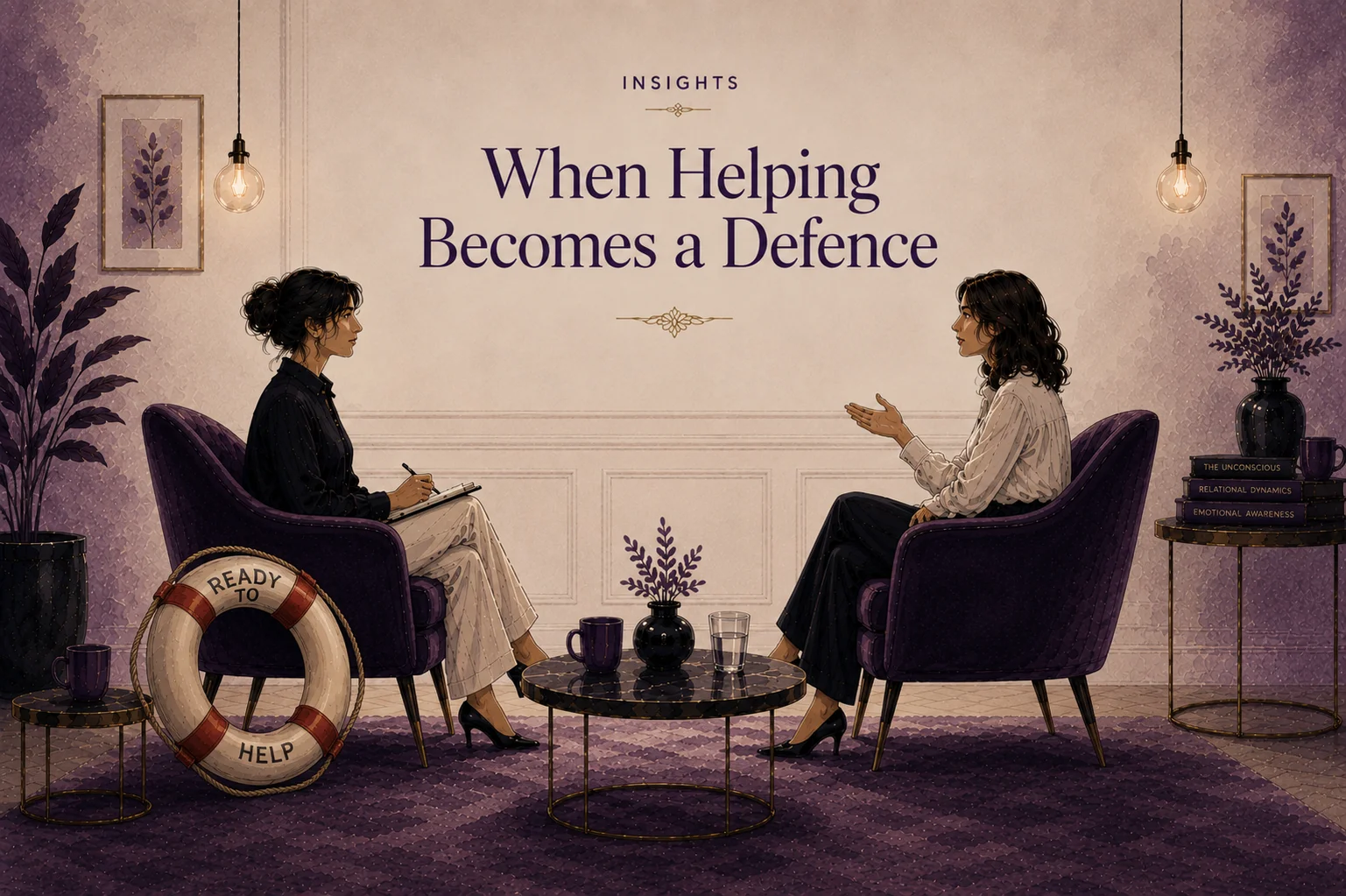
When I’m teaching defence mechanisms one of the things that surprises people the most is that altruism is classed as a mature defence mechanism, alongside others such as humour and anticipation. It can do us a lot of good, helping other people. But it can also stop us from thinking about ourselves, when really we need a bit of care and attention. And perhaps this is the question to ask ourselves when we’re offering an observation or framing a question in a particular way. Where is the urge to help coming from? Sometimes an observation is just that. But sometimes it’s a response to something that’s going on inside of us. And perhaps the most useful thing we can do for the client is to notice that.